
Kolumbia Banana Split
Country / Region: Colombia, Huila – Acevedo
Process: Natural (Natural Anaerobic)
Variety: Castillo
Altitude: 1600–1900 masl
Harvest: Mitaca crop 2025/2026
Cupping score: 86.5
Producers / Processing leaders: Nestor Lasso & Jhoan Vergara
Cherry sourcing: smallholder farmers delivering cherries to Peñas Blancas
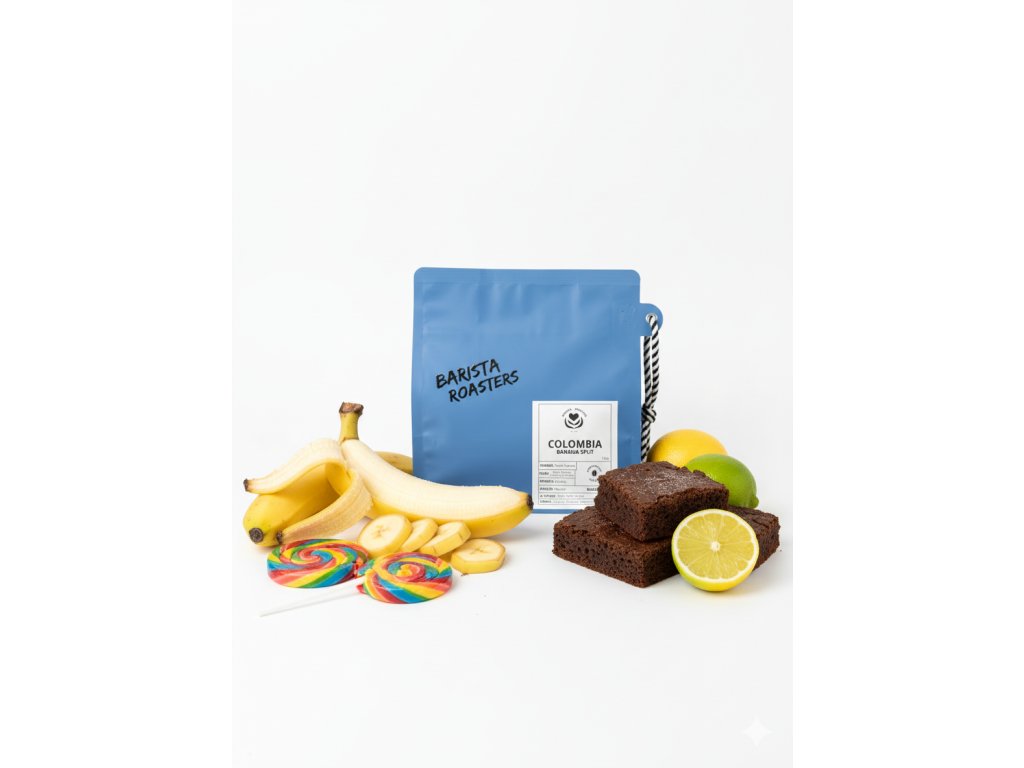
A coffee that drinks like dessert, yet stays clean, structured, and vibrant. Expect candy-like sweetness, banana ice cream with chocolate, brownie, and a bright citrus acidity in the cup.


Why this coffee is exceptional
This is not “just” a natural. It’s the result of highly controlled anaerobic pre-fermentation and slow drying, designed to push sweetness and aromatics into a distinct candy-dessert spectrum—without losing clarity or structure. Peñas Blancas works with repeatable protocols that consistently amplify fruit intensity, florals, and creamy sweetness.
Processing: how Peñas Blancas Natural Anaerobic is made
At Peñas Blancas, every step is engineered for quality:
-
Selective picking – only fully ripe cherries with high sugar content.
-
Sorting (flotation & density) – removing underripe and defective fruit.
-
Anaerobic pre-fermentation – whole cherries ferment without oxygen for 48–72 hours, enhancing fruit-forward and floral character.
-
Slow drying – 25–30 days on African beds, supporting even sugar development and stability.
-
Stabilisation & dry milling – resting, then hulling and final sorting for export.
Peñas Blancas: more than a processing center
Peñas Blancas Coffee Processing Center operates as a community-driven initiative and social project in Acevedo (Huila). The goal is to remove the barriers that often keep smallholders from accessing the specialty market—limited infrastructure, inconsistent processing quality, and lack of technical know-how—by providing protocols, training, quality control, and a more transparent path to better prices.
The center is led by Nestor Lasso (fermentation development, quality control, innovation) and Jhoan Vergara(community work, logistics, and building stable, fair relationships with farmers).
In practice, this means smallholder cherries can be transformed into coffees that perform like top-tier estate microlots—clean, expressive, and competition-level in character—while supporting long-term sustainability for the producing community.
List of ratings
 Erich Vinclav
Be the first who will post an article to this item!